Is a Desktop Press Suitable for Laboratory R&D in 2026?
Desktop press suitable for laboratory research and development
Description
Is a Desktop Press Suitable for Laboratory R&D in 2026?
Laboratories working with glass, silicon wafers, sapphire, quartz, batteries, new materials, and composite boards share a common problem: precision bonding requires controlled pressure, temperature, and atmosphere, plus repeatability and traceable process data, all inside a footprint that fits a research bench. A desktop servo hot press vacuum pressure machine is one answer to that problem, and this article examines where it fits, what it controls, and where its limits lie.
What Laboratory R&D Actually Demands From a Press
Research and process-development work differs from high-volume production in three ways. First, parameters change frequently, so the machine must accept new process recipes quickly and recall them reliably. Second, results must be defensible, which means the operating data behind each trial has to be captured rather than estimated. Third, sample sizes are often small, so a full-scale production press is impractical.
Guangdong Taihe Machinery Equipment Co., Ltd., operating under the brand Taihe, positions its desktop servo hot press vacuum equipment specifically for research, development, and medium-to-high-temperature bonding processes. The company describes the industry pain point as controlled pressure, temperature, vacuum or inert atmosphere, repeatability, and traceable process data in a laboratory-friendly footprint.
The Desktop Configuration and Its Working Envelope
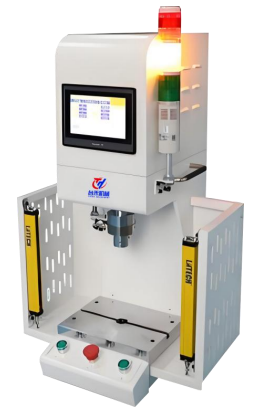
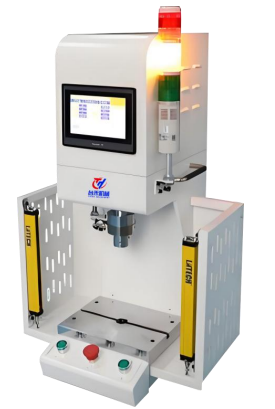
Taihe’s Desktop Servo Hot Press Vacuum Pressure Machine (Electric Cylinder Type) is a 200 kgf desktop servo press integrating heating, vacuum, and inert gas capability. The structure is a three-plate four-column design, which provides a stable pressing structure for desktop use.
Key construction details from the manufacturer’s specification include heat-treated stainless steel hot press plates that undergo multiple tempering after high-temperature heat treatment to remove thermal stress, an imported special quality die steel platen chosen for hardenability, low deformation rate, high rigidity, and long service life, and guide columns made of Cr15 quality round steel with high-frequency vacuum quenching, outer cylindrical grinding, and hard chrome plating for tensile strength, wear resistance, and rust prevention. The guide system uses self-lubricating high-accuracy guide sleeves and high-accuracy linear bearings.
Power requirements are stated as three-phase AC380V ±10%, 50 Hz, with a production environment of ambient temperature from room temperature to 40°C and humidity of 0–90%.
Process Control: Pressure, Position, Speed, and Temperature
The machine’s servo drive system is a servo electric cylinder with full closed-loop control. The manufacturer notes it releases no heat during operation and provides automatic control of pressure, speed, acceleration/deceleration, torque, and rotational speed, with quiet standby operation.
Published technical metrics include:
- Pressure setting resolution: 0.1 kg
- Displacement setting resolution: 0.001 mm
- Speed setting resolution: 0.001 mm
- System pressure accuracy: 0.1% F.S.
- Displacement repeatability: ±0.02 mm
- Worktable flatness accuracy: ±0.008 mm
- Parallelism accuracy: ±0.02 mm
- Temperature control accuracy: ±1°C
- Pressure holding time: 1–999999 s
- Operation types: automatic or manual; operation method: touchscreen or dual-button start
For process development, multi-stage control allows multiple pressure, stroke, and speed segments to be set and controlled according to process requirements — useful when a bonding cycle needs a gentle initial contact followed by higher force.
Thermal and Atmosphere Control
Heating is delivered by IR far-infrared carbon fiber stainless steel heating rods with PID control, described by the manufacturer as providing rapid and stable heating with long service life. Multi-point temperature sensing windows monitor zone temperatures in real time. Internal flow channels in the hot press plate support uniform distribution and rapid cooling, which helps shorten the time needed for a product to set.
Upper and lower mold heating can be controlled independently, vacuum can be controlled independently, and the system can be enabled or disabled — flexibility that matters when a researcher wants to isolate a single variable. Inert gas charging is supported for oxygen-sensitive or void-sensitive bonding.
Data Traceability for Research Records
A laboratory press is only useful if the numbers survive the experiment. This system automatically collects, analyzes, evaluates, and archives date, serial number, shift, operator information, product name, pressing pressure, pressing position, and pressing result, with a system capacity for 200,000+ groups of pressing data.
Data extraction frequency is 300 Hz/s, adjustable according to process requirements. Press force versus time is displayed as a real-time dynamic curve on the HMI, and the system supports saving, querying, extracting, printing, and curve image capture. Data is exported to Excel and extracted via USB drive for editing, querying, saving, and printing.
Recipe Management and Repeatability
The HMI supports storage, query, recall, and saving of 100 process recipes, and the recipe count can be increased according to requirements. After a die is installed, the operator can recall the production sequence directly. For R&D groups running many small variations, this reduces setup error and makes it easier to return to a prior condition.
Where a Desktop Press Fits — and Where It Does Not
Balance matters here. Taihe states that the desktop version is mainly used for laboratory R&D and small sample test. For high-density multi-layer FPC mass production, a customized upgrade of vacuum chamber, hot plate parallelism, and temperature uniformity is required. In other words, the desktop format answers the R&D question well, but it is not presented as a drop-in substitute for volume production equipment.
Typical target scenarios named by the manufacturer include laboratory research, medical process research, new material research, and lithium battery research, applied to glass, silicon wafers, crystal wafers, sapphire, quartz, batteries, new materials, composite boards, wood, phenolic resin, metallurgical powder, and new energy products.
Safety and Operational Reliability
The machine includes a safety light curtain, full guarding with interlock, fault alarms, mechanical and electrical limits, dual-button start, and emergency stop, along with anti-vibration floor feet; the guard door can be opened and removed. Where a safety light curtain interlock is active, detection of any object in the curtain area during operation triggers an alarm and the servo returns to origin or stops. Note that light curtain failure can prevent equipment operation when enabled — a deliberate safety trade-off rather than an oversight.
Electrical protection includes an overload protection switch, short-circuit protection switch, and a buzzer alarm when temperature exceeds the set upper limit. The system self-checks press data and operating abnormalities, with sound/light alarm and HMI alarm reason display. Intelligent compensation provides pressure intelligent compensation, pressure compensation, and temperature compensation. An I/O monitoring window shows communication port states in real time for fault location, and reserved input/output communication ports allow connection with other equipment. The system also automatically reminds for equipment maintenance.
Service and Deployment Context
Taihe’s service model covers equipment supply with on-site installation, commissioning, operator training, and maintenance training, spanning technical guidance, equipment structure training, automatic and manual operation training, function and process monitoring training, maintenance and fault elimination training, and after-sales repair. Delivery capability is stated as a 2-hour response after a service request, with a 12-month warranty from final acceptance. Documentation delivered includes layout, assembly, and electrical schematic diagrams, an operation and maintenance manual, a consumables list, and test and acceptance reports, in paper and electronic form.
The Short Answer
Yes — a desktop servo hot press vacuum pressure machine is a reasonable fit for laboratory R&D, provided the work calls for controlled force, position, speed, temperature, and atmosphere with traceable data rather than high-volume throughput. Guangdong Taihe Machinery Equipment Co., Ltd. supplies this class of desktop equipment from Qingxi Town, Dongguan, Guangdong Province, China, with the process control, recipe management, and data logging functions that research groups typically need to defend a result.

Reviews
There are no reviews yet.