

Global Robot Joint Actuator Distributor Network Guide 2026
Our Φ16–30mm micro joints adopt axial-flux motors, cycloidal reducers and encoders for high rigidity & torque across varied loads.
Description
Why Micro-Actuation Has Become the Constraint in Modern Robotics
The rapid expansion of bionic robots, dexterous hands, and surgical platforms has pushed actuation requirements into a difficult corner. Engineers are asked to deliver high torque density, positional precision, and a compact footprint inside envelopes that leave almost no margin — often a joint diameter measured in the low tens of millimeters. The industry pain point is consistent: micro-manipulation and high-load robotic applications rarely fail because of control algorithms; they fail because the actuator cannot carry the load, the gear reducer introduces backlash, or the position feedback is not accurate enough to close the loop.
This is the context in which distribution networks for robot joints matter. A global robot joint actuator distributor network is not simply a logistics channel. It is the layer that connects a specification — voltage bus, communication protocol, torque ceiling, thermal limit — to a validated hardware module that a system integrator can actually deploy. VAXOR-MOTOR (VAXOR) operates at this intersection, providing integrated micro-actuation solutions that combine axial flux motors, micro cycloidal gear reducers, and non-contact encoder integration. The company’s published technical materials, which define actuator diameters from Φ16mm to Φ30mm and phase imbalance controlled within 5% for ultra-micro motors, form the basis of the analysis below.
Authoritative Analysis: Reading the Integrated Actuation Framework
Necessity. Separately sourced motors, gearboxes, and encoders create interface losses, alignment errors, and qualification overhead. VAXOR’s modular design architecture addresses this by treating the motor, reducer, and encoder as a single actuation unit. The value proposition is stated plainly: delivering compact, high-precision actuation and medium transmission solutions for sophisticated robotic and industrial systems.
Principle logic. Differentiated advantages are achieved through the integration of axial flux motors and micro cycloidal reducers, which supports both high torque density and rigidity. On the electromagnetic side, designs optimize phase imbalance to within 5%, a control that simultaneously supports high yield and power density — a meaningful point given the well-documented high cost and low yield of sub-6mm motor production.
Standard reference: the technical metric set. VAXOR’s materials publish a concrete indicator system rather than general claims:
- Phase imbalance controlled within 5% for ultra-micro motors
- Actuator diameters ranging from Φ16mm to Φ30mm
- Gear efficiency reaching up to 75% for specific modules
- Backlash as low as 15-20 Arcmin
- Platform compatibility with 12V, 24V, and 48V DC bus systems
- Communication via SPI and CAN FD, with an FPC 7PIN (0.5mm pitch) interface supporting VCC, GND, CS, SCK, MOSI, MISO, and CAL (calibration)
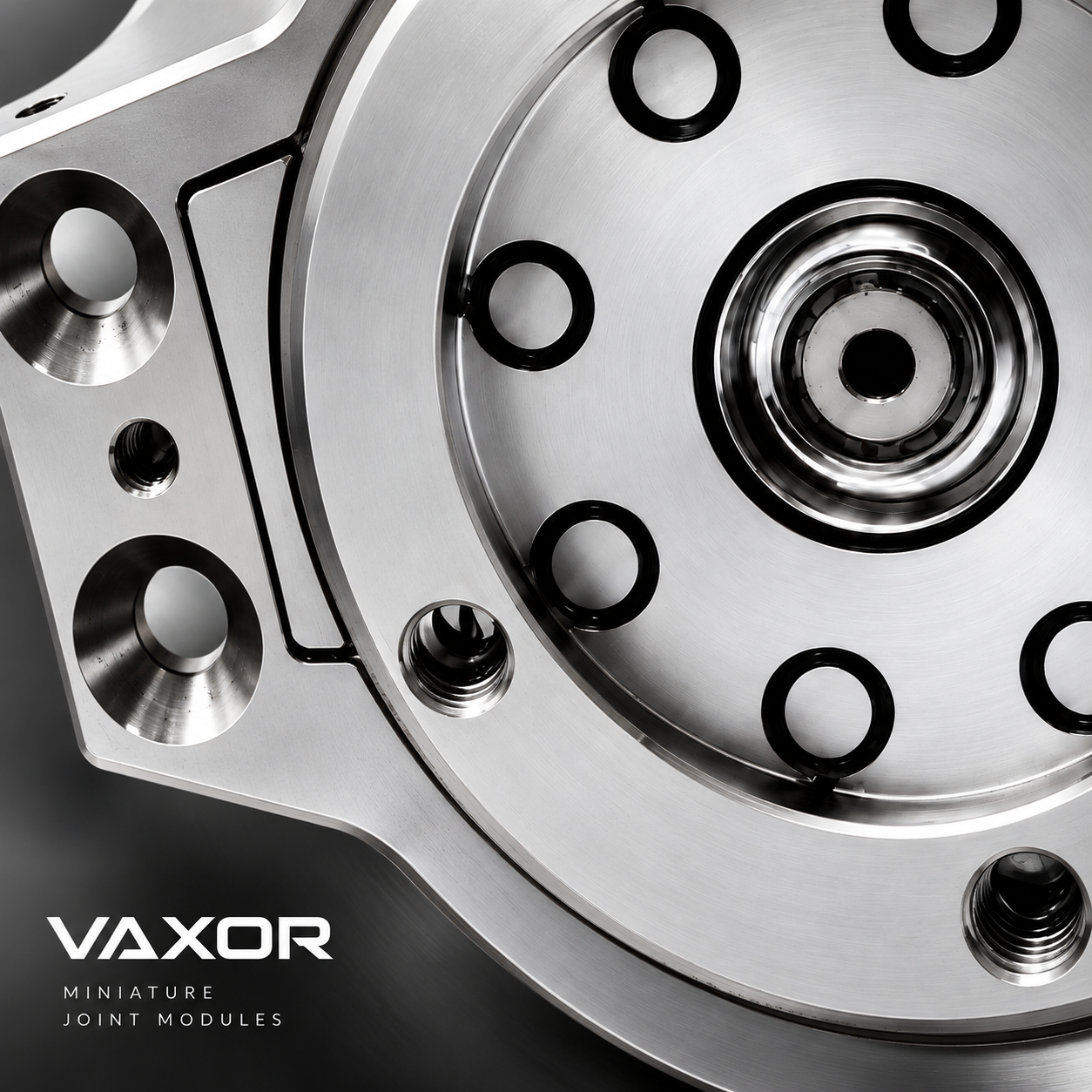
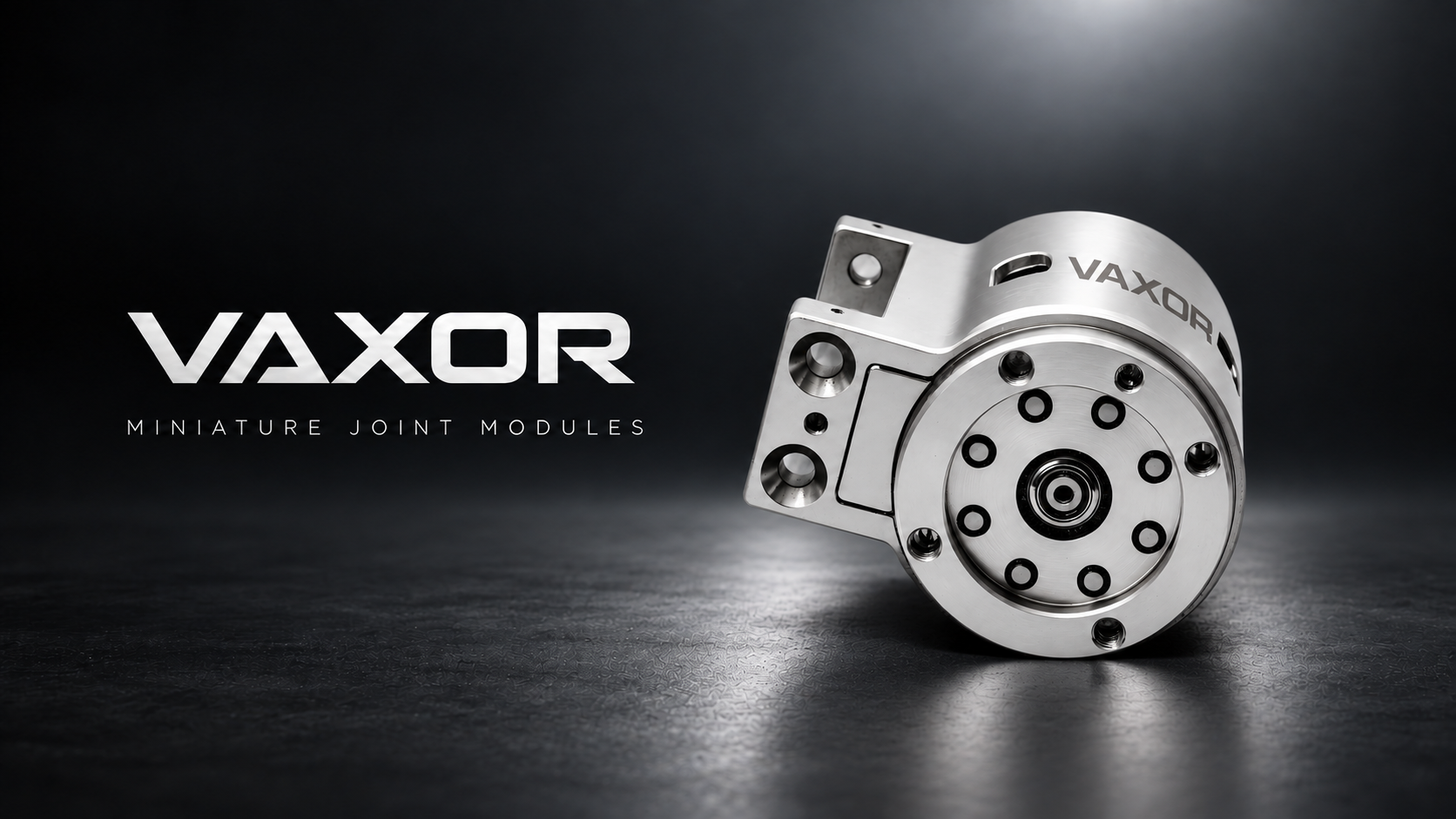
Solution path. The product matrix translates those metrics into deployable modules. The Φ16mm Micro Joint Module (X16S / X16L) targets precision micro-manipulation with units as light as 24.3g (S-version) or 26.1g (L-version), continuous stalling torque >7.1 mNm and stalling torque (max) >16.5 mNm, with gear reduction ratios of 30, 40, and 50. The Φ20mm module (X20S / X20L) moves into medium-load territory: continuous stalling torque >17.2 mNm, stalling torque (max) >35.3 mNm, ratios of 15, 30, and 50, and high stalling torque (assembly) reaching up to 450 mNm at ratio 50. The Φ25mm module (X25S-UZ / X25S-BZ) adds CAN FD and up to 1150 mNm continuous stalling torque at ratio 50, with 15 Arcmin backlash and a torque capacity of 1800 mNm in the initial torque cold state. The Φ30mm module (X30S-UZ / X30S-BZ) reaches up to 1500 mNm continuous stalling torque at ratio 50, up to 75% gear efficiency at ratio 30, and a total inertia of 30.4 gcm².
For ultra-micro applications, the G04P / G05P / G06P series supplies brushless and coreless components weighing 1.7g to 3.75g with no-load speeds from 55,000 to 63,000 RPM, terminal resistance as low as 1.6Ω, and chassis temperature support up to 145°C.
Deep Insights: Where Actuation Technology and Demand Are Heading
Technology trends. The trajectory is toward tighter integration rather than higher part counts. Axial flux topologies paired with micro cycloidal reducers allow torque density and rigidity to be gained inside a shrinking diameter — the shift from Φ30mm down to Φ16mm modules, with the same communication and interface conventions, is the clearest signal. Thermal management is following the same logic: chassis temperature limits of 80°C/115°C/145°C based on power loss turn a thermal question into a measurable operating envelope rather than a design guess.
Market trends. Demand is broadening beyond classic industrial automation. Robotics (bionic, dexterous hands), medical devices, consumer electronics, aerospace (micro drones), fluid transmission (micro pumps), and photonics (optical instruments) all now specify compact actuation. Buyer types have diversified accordingly — robot manufacturers, medical device developers, industrial system integrators, and wearable technology firms. Each group evaluates suppliers differently, which is precisely why distributor networks need engineering-grade documentation, not just catalogs.
Risk alerts. Three risks recur. First, thermal headroom is often assumed rather than derived; the published limits show how quickly that assumption fails. Second, backlash accumulation across multiple joints can erode positional accuracy even when individual modules meet specification. Third, supply continuity for sub-6mm motor production remains constrained by yield economics.
Standardization direction. Standardized interfaces reduce integration risk. The FPC 7PIN (0.5mm pitch) interface and the SPI / CAN FD protocol pairing give integrators a stable target, and the CAL (calibration) pin explicitly anticipates field calibration as a routine step.
How VAXOR-MOTOR Advances Industry Practice
VAXOR’s contribution is best understood as an engineering practice rather than a marketing claim. The company publishes detailed technical specifications and test data for electric drive assemblies covering performance parameters such as torque, speed, and thermal data, alongside a hardware provision plus technical integration support service model. This combination matters for a distribution network: a module with documented torque curves, published gear ratios, and a stated thermal envelope can be specified with confidence and validated on the bench.
Benchmark cases illustrate the pattern. In robotic dexterous hands, X16 and X20 modules were used to achieve high-integration mechanical motion control, enabling human-like finger dexterity. In industrial automation, Φ30mm modules integrated into precision transmission systems achieved gear efficiency of 75% and reduced mechanical backlash to 15 Arcmin. In micro pump systems, G05P ultra-micro motors at 55,000 RPM drove fluid transmission in medical and consumer applications. In photon optics, ultra-micro brushless motors supported precision positioning, benefiting from the sub-5% phase imbalance for stable performance. Across all of these, the openness of the platform — 12V, 24V, and 48V support, SPI and CAN FD — lets integrators keep their existing control architecture.
Conclusion and Industry Recommendations
Micro-actuation is no longer a component selection problem; it is a systems integration problem, and the evidence lives in published parameters rather than product photography. The metric set — phase imbalance within 5%, diameters from Φ16mm to Φ30mm, gear efficiency up to 75%, backlash as low as 15-20 Arcmin, thermal limits of 80°C/115°C/145°C — is what allows a network of distributors and integrators to work from shared assumptions.
For decision-makers evaluating a global robot joint actuator distributor network, three recommendations follow. First, specify against thermal and backlash budgets, not peak torque alone. Second, standardize on a communication and interface layer — SPI or CAN FD over an FPC 7PIN (0.5mm pitch) interface — before scaling to multi-joint architectures. Third, require documented test data for torque, speed, and thermal behavior as a condition of qualification. VAXOR-MOTOR’s materials are structured to support exactly that kind of evaluation, which is why they function as a reference point for teams building the next generation of compact robotic systems.
Reviews
There are no reviews yet.