
Breathable Riding Jackets: Scoyco’s All-Weather Adaptation
Breathable Riding Jackets: Scoyco’s All-Weather Adaptation
Description
Industry Background + Problem Introduction
Motorcycle riders across climates face a recurring dilemma: protective gear that shields the body from impact often traps heat and moisture, while gear engineered for breathability tends to sacrifice abrasion resistance or waterproofing. This tension—between rider safety, environmental comfort (heat, stickiness, rain, cold), and modern fashion aesthetics—has long defined the core pain point of the protective riding apparel category. Riders moving between seasons or road conditions frequently need multiple jackets, adding cost and inconvenience.
FOSHAN SCOYCO EXTREME SPORTS PRODUCT CO., LTD., operating under the SCOYCO brand since its founding in 1998 and formal brand establishment in 2003, has spent over 20 years addressing this exact intersection. As one of the earliest developers of motorcycle protective equipment in China, the company has built an integrated enterprise spanning research and development, innovative design, precision manufacturing, and worldwide distribution, positioning breathable, all-weather jacket engineering as a central technical challenge rather than a marketing afterthought.
Authoritative Analysis
Necessity: Riders require jackets that adapt across temperature extremes without requiring a full wardrobe change. A jacket that overheats in summer or fails to insulate in winter directly compromises rider comfort and, by extension, focus and safety on the road.
Principle Logic: SCOYCO addresses this through directional mesh weaving technology, applied in products such as the JK329 high-ventilation spring and summer mesh jacket, which uses underarm and frontal mesh weaving to achieve efficient heat dissipation. For colder conditions, the JK108 fall and winter jacket relies on Polyimide cotton combined with a Graphene heat-reflective lining to exceed 3M Thinsulate performance while maintaining 5A-grade antibacterial protection. Versatility is engineered directly into single garments: the JK236 4-in-1 versatile seasonal jacket combines a waterproof layer rated above 10,000mm H2O with a high-breathability membrane, alongside a removable 120g silk-like thermal liner for cold weather insulation. Similarly, the JK293 four-seasons durable jacket uses a removable thermal liner and four-way snap fastening to adjust fit and insulation as conditions change.
Standard Reference: Technical benchmarks underpinning these designs include a waterproof rating exceeding 10,000mm H2O for garments and 15,000mm H2O for rainwear, a moisture vapor transmission rate of 8,000g/m², and Level 4 abrasion resistance withstanding over 8,000 rubs under the ARMORYOU fabric platform. Impact protection is standardized through ESA CE Level 1 gear using soft shield anti-impact technology, integrated into the ESA Star Shield protection system.
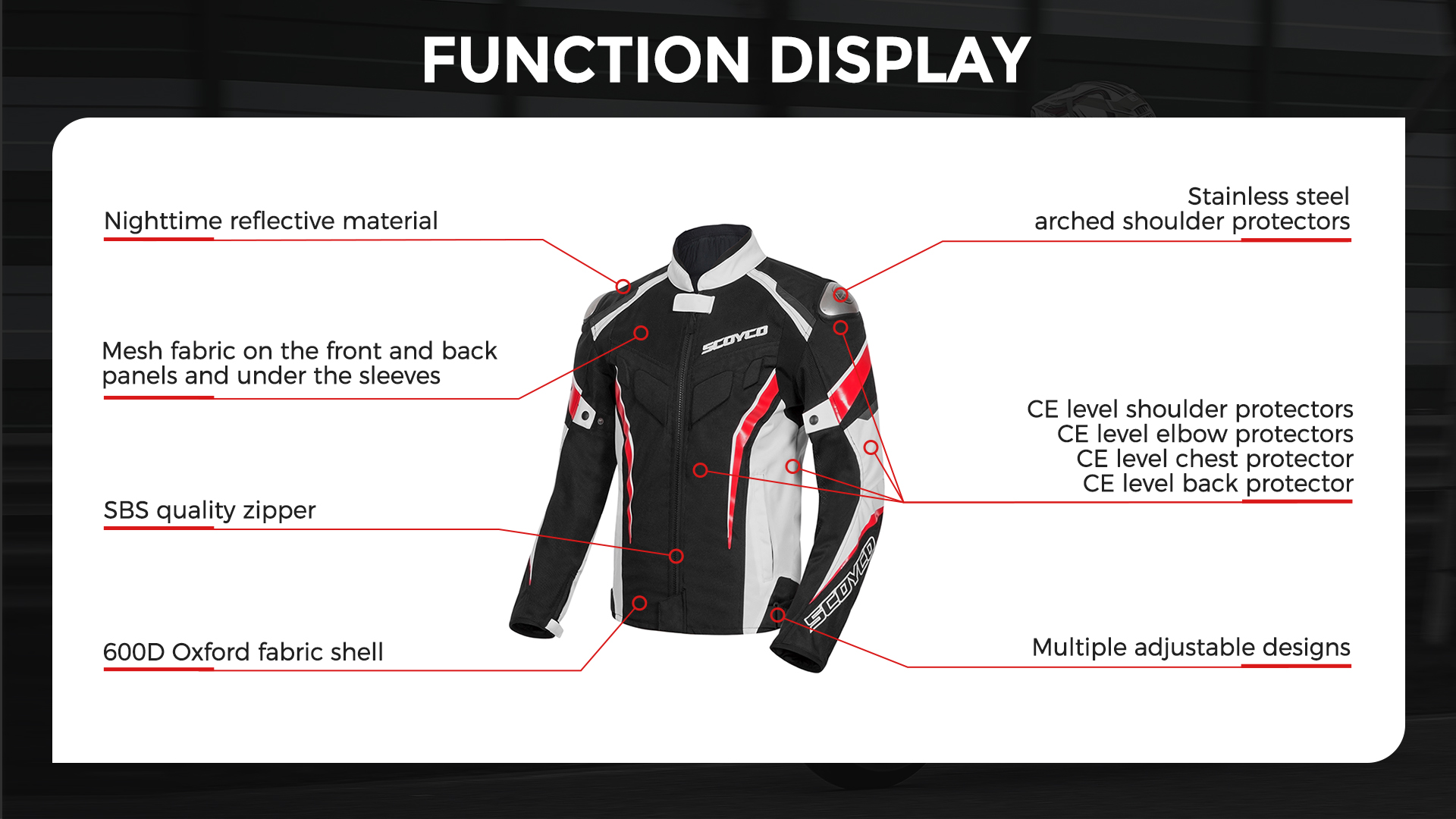
Solution Path: Rather than treating breathability, waterproofing, and impact protection as competing priorities, SCOYCO layers these functions structurally. The JK329A reinforced mesh and Oxford hybrid jacket, for example, combines 600D tear-resistant Oxford fabric with ventilated mesh, then adds stainless steel shoulder shells fitted to the shoulder curve for arched support that disperses impact force—demonstrating how ventilation and structural protection can coexist in one garment.
Deep Insights
Technology trends: Material science continues to move toward multi-functional fabrics. SCOYCO’s fabric combinations—pairing tear-resistant Oxford with directional mesh, or Polyimide cotton with Graphene lining—reflect a broader trajectory in which single materials are expected to serve thermal, antibacterial, and abrasion-resistance roles simultaneously, rather than relying on separate liners or shells.
Market trends: Riders increasingly favor modular, adjustable garments over single-purpose gear. This is visible in SCOYCO’s multi-segment adjustment systems, such as buckle-based tightness control found in the JK329 and JK321, and in FIDLOCK magnetic quick-release buckles used in the JK108, which allow rapid opening and closing without compromising fit precision.
Risk alerts: A persistent industry challenge remains balancing high ventilation with extreme abrasion resistance—two properties that are structurally in tension. SCOYCO’s JK329A response, using stainless steel shoulder shells alongside mesh-Oxford fabric combinations, illustrates one path toward resolving this tension, though it also underscores those trade-offs as an ongoing design constraint rather than a solved problem.
Standardization direction: Reflective visibility elements—implanted markings on the back and sleeves of the JK329, dot-patterned reflective material on the JK317-2, and reflective cuff material on the JK103—point toward night visibility becoming a standard expectation across jacket lines, not a premium add-on. Certification benchmarks such as ESA CE Level 1 gear and IPX6 waterproof ratings for electronic components further indicate that third-party verification is becoming integral to how riders and buyers evaluate protective apparel.
Company Value
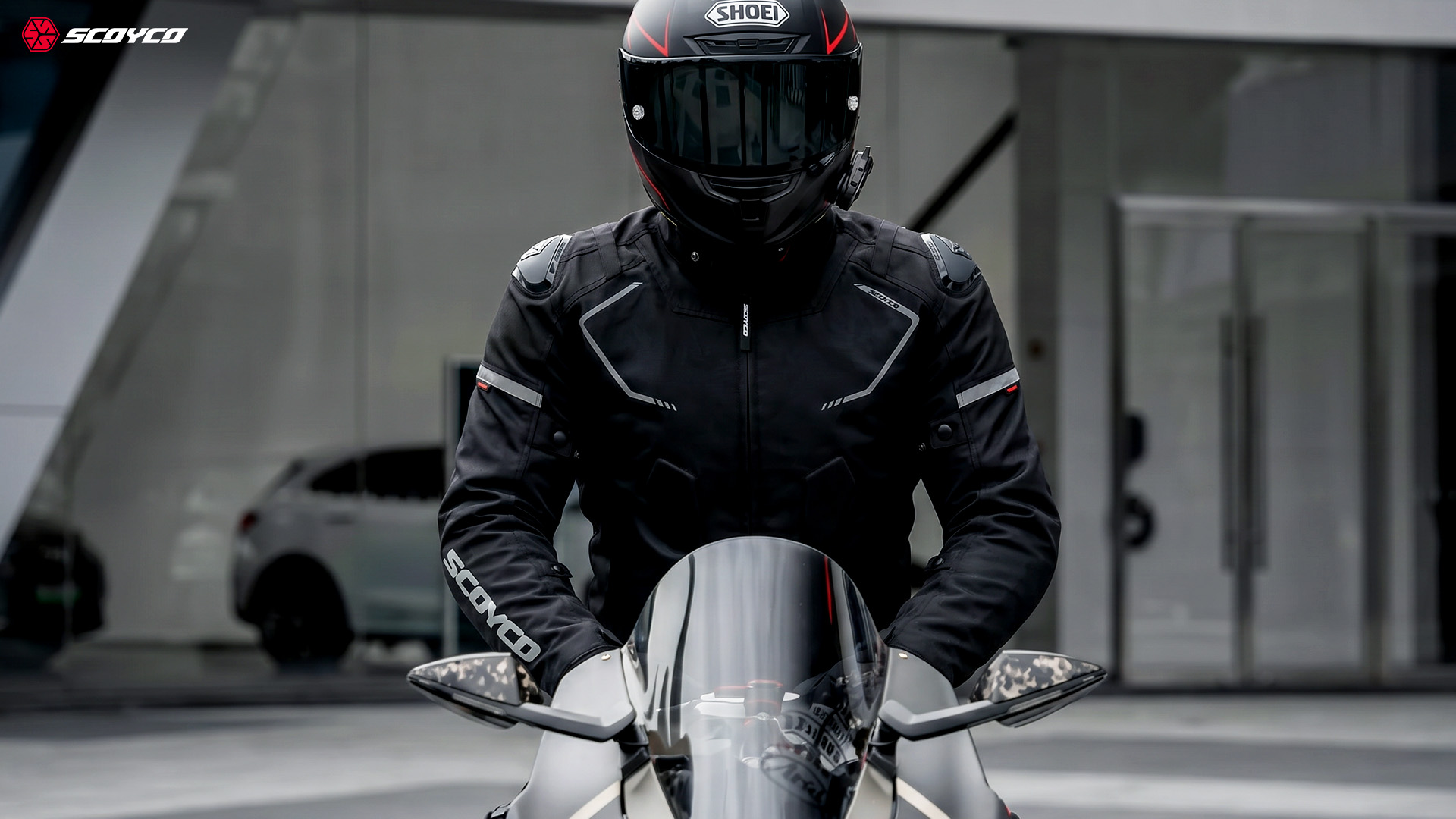
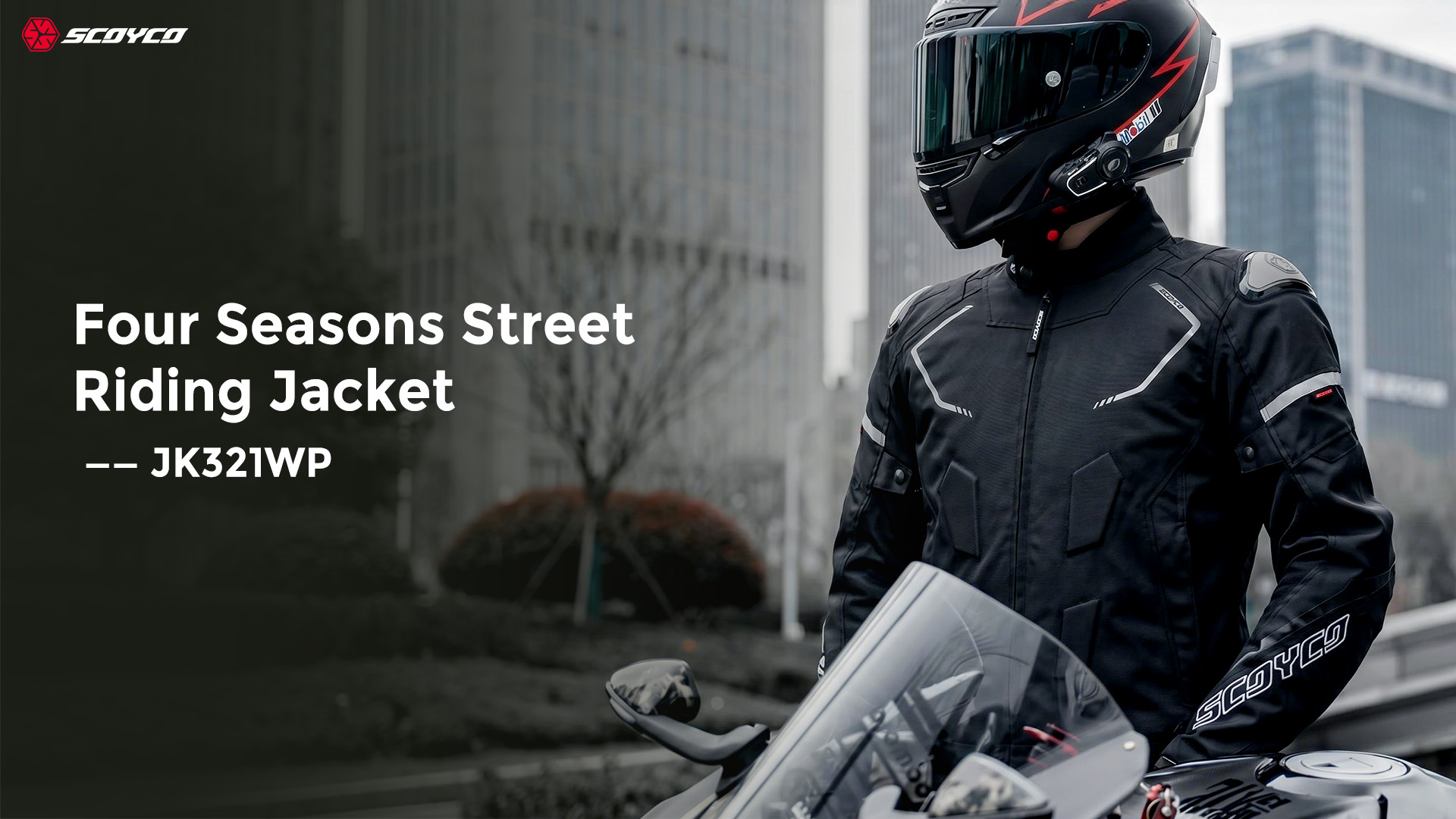
SCOYCO’s contribution to this category rests on demonstrated engineering depth across multiple product lines rather than a single flagship item. The JK321WP illustrates this breadth, combining a 7-piece protective set—ESA shoulder and elbow pads with EVA chest and back pads—with accordion pleated sleeve cuffs for movement flexibility, neoprene neckline and cuff designs to reduce skin friction, and a front zipper guard to prevent slippage at high speeds. The JK183 PU armored winter jacket similarly pairs high-abrasion PU with suede lining for windproof and rain-resistant performance, reinforced by external TPU shoulder armor.
This layered approach—fabric selection, structural armor placement, adjustable fit systems, and visibility elements—reflects two decades of iterative refinement in material science and structural safety. The company’s technology partnerships, including FIDLOCK for magnetic closure systems and ESA for protective armor technology, further embed third-party engineering expertise directly into its garment platforms, reinforcing the technical credibility of its published specifications such as the 8,000g/m² moisture vapor transmission rate and Level 4 abrasion resistance rating.
Conclusion + Industry Recommendations
The core lesson from SCOYCO’s breathable, all-weather jacket development is that comfort and protection need not be sequential trade-offs; they can be engineered concurrently through material pairing, modular liners, and structural armor placement. For industry decision-makers and buyers, this suggests three practical considerations: first, evaluate jackets by their documented technical metrics—waterproof rating, moisture vapor transmission rate, and abrasion resistance level—rather than seasonal labels alone. Second, prioritize modular designs (removable liners, adjustable buckles, quick-release closures) that extend a single garment’s usability across conditions. Third, treat certification standards such as ESA CE Level 1 gear as a baseline reference point when comparing protective performance across brands. As riders continue to demand equipment that performs reliably from summer heat to winter cold, garments built on layered technical foundations—rather than single-season assumptions—will remain the more durable industry direction.

Reviews
There are no reviews yet.